Roofing + skylight decision system
JB’s Roofing
Weather Out. Daylight In.
A long dual-service identity—JB’s Roofing / Central Coast Skylight Solutions—becomes a simple proposed choice architecture: protect the roof, bring in daylight, or ask for help deciding.
- Google Maps 4.8 · 24 reviews
- Snapshot checked Sep. 6, 2026
- No website attached to Maps
- 1356 Breck St · SLO
The website, redesigned 1
Explore the working site.
Four pages. A distinct customer journey. An independent codebase.
Scroll inside the preview, or open the full site. Forms and planners do not send requests or make bookings.
Reimagined local launch
Turn a dual trade into one memorable choice.
The transformation preserves both public names while giving homeowners a human first question: is the priority weather protection, natural light, or help understanding the overlap?
Translate roofing and skylight complexity into a legible, photo-supported assessment path.
People responding to a concern, planning an improvement, or unsure which specialist they need.
Share issue type, timing, property context, and photos without receiving a remote promise.
A pitched protective line opens into a square of daylight across every format.
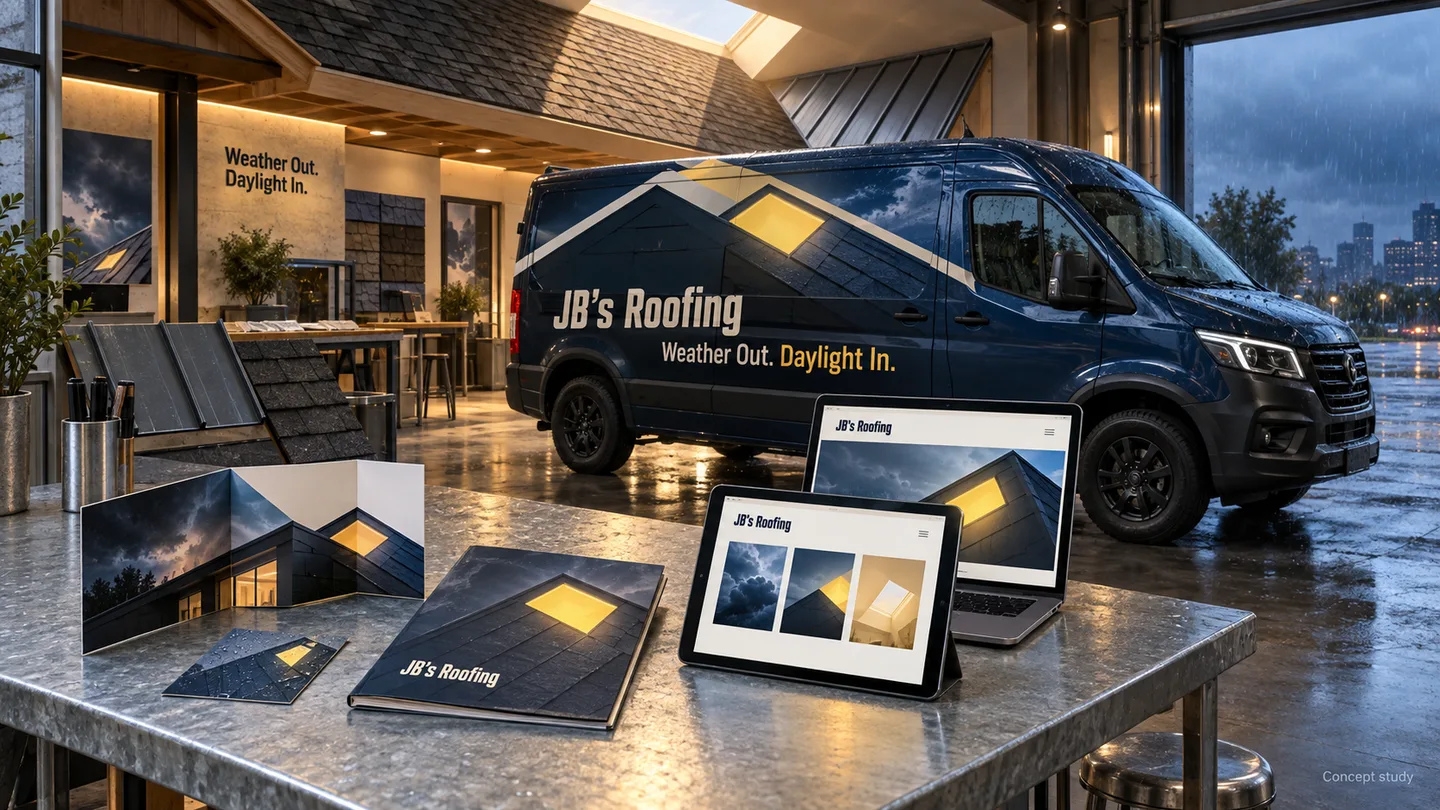
The idea, in every medium.
Protect the roof. Open the room.
Begin with weather, daylight, or “I’m not sure.” Add context and photos for a structured assessment request—not an online diagnosis or quote.
Dry above. Bright below.
Roof + light, one clear assessment.
Dry above and bright below. Open the outdoor concept detail.What does the room need overhead?
The vehicle’s own roof becomes the canvas for a storm-to-daylight transition, readable without a dense service list.
A launch, not just a look.
- Phase 01 · Verify
Resolve the operating truth
Confirm business naming, services, licenses, permits, warranties, service area, scheduling, emergency availability, materials, and authoritative contact routes.
- Phase 02 · Frame
Test the three-door intake
Prototype weather, daylight, and unsure paths with real customer questions; connect the site, report, mailer, signs, and fleet to one vocabulary.
- Phase 03 · Illuminate
Launch with verified project evidence
Add consented exterior/interior project pairs, accurate scope notes, and date-stamped operational details under a named content owner.
Three large choices lead to an accessible assessment form, process explanation, verified evidence, and one canonical contact record.
Roofing and skylight language, identity, phone, location, service area, and licensing references stay reconciled across every public profile.
“Dry above. Bright below.” identifies the system while project-specific information appears only with owner and homeowner approval.
A weather/daylight foldout helps recipients recognize which conversation to start without manufacturing urgency or fear.
An annotated Roof + Light Report separates verified observations, photos, options, dependencies, and customer-approved next steps.
A roofline aperture wraps the actual body geometry; road-speed copy stays minimal and a deeper path appears only where safe when parked.
A hypothetical cutaway lab becomes operator-approved educational content about questions, layers, and daylight placement—not DIY repair advice.
A modular assessment deck and project recap use the same roof/light choice so the handoff does not restart from zero.
Storm outside, daylight inside.
Midnight blue, cloud ivory, galvanized gray, rain blue, and one skylight yellow. Exterior protection and interior light appear as paired frames. The voice is plain, measured, and non-alarmist: “Tell us what you notice overhead.”
Measure which doorway earns a real assessment.
- Website, three-door intake, identity architecture, jobsite signs, foldout, report, cutaway kit, sales deck, and vehicle-family templates.
- Before production: verify licensing, services, permits, emergency scope, service area, materials, warranties, contacts, and image permission.
- Measure path choice, completed assessment requests, qualified calls, photo uploads, directions, and roof-versus-skylight demand mix.
Demo brand kit
A two-state system that reads as protection from the street and daylight in the room. Open each tile for the proposed rules.
Palette
Prototype colors: storm blue #10233A, cloud ivory #FFF9EB, galvanized gray #78909C, and skylight yellow #FFD75C. Exterior longevity and contrast would be tested.
TypographyDry above. Bright below.
A squared condensed display face supports short structural messages; a warm utility sans carries forms, reports, licensing, specifications, and mobile copy.
Graphic deviceThe roof aperture.
A protective pitch crosses a daylight square. It can become a crop, divider, window, diagram key, van stripe, or physical cutout without relying on a logo.
Voice + materialWhat does the room need overhead?
Calm, specific, and choice-led. Weather-tough sign materials, translucent yellow layers, technical report stock, and restrained reflective details express the two-part promise.
Open every artifact
01 · Website Weather, daylight, or unsure
The home page begins with intent and progressively asks only the questions needed for a useful follow-up.
- Content: need, property context, timing, issue location, optional photos, and reply preference.
- Production: accessible upload, clear errors, confirmation, privacy, and real workflow routing.
- Constraint: no diagnosis, price, availability, or emergency promise is automated.
02 · Jobsite + outdoor Dry above. Bright below.
The binary message works at distance while details remain with the stationary project sign or verified destination.
- Content: one line, business identity, approved project category, and contact path.
- Production: permits, sightlines, wind, reflectivity, installation, and removal plan.
- Constraint: property use and project descriptions require approval.
03 · Direct mail Roof + light decision foldout
The foldout opens from an exterior roof plane to an interior daylight field and ends with three request paths.
- Content: observation prompts, decision questions, verified service fit, and one current route.
- Production: postal-safe construction, household segment codes, and web equivalent.
- Constraint: no invented seasonal discount or fear-based safety claim.
04 · Field card Roof + Light assessment record
A compact record connects each photo or observation to a location, category, and next-step status.
- Content: observed condition, roof/light/both tag, dependency, option, and follow-up.
- Production: weather-resistant field version plus accessible digital recap.
- Constraint: terminology and record status require operator and legal review.
05 · Demonstration Roof + Light Lab
A portable cutaway makes hidden layers and daylight decisions discussable without climbing a roof.
- Experience: layer labels, question prompts, daylight aperture, material handling, and consultation path.
- Production: safe demo construction, modular signs, captions, handout, and follow-up.
- Constraint: hypothetical activation only; no event or material endorsement is announced.
06 · Measurement Choice-to-assessment signals
The plan tests whether the three-door architecture routes people correctly rather than promising lead volume.
- Primary: path choice, completed requests, qualified calls, uploads, and directions.
- Quality: misrouted needs, incomplete fields, response gaps, and assessment outcomes.
- Governance: baseline, consent, retention, attribution, and reporting owner set first.
07 · Fleet + vans Storm-to-daylight roofline
The wrap uses the actual vehicle roof to separate protection from light while preserving legibility and service access.
- Side: roof aperture, short line, identity, and verified contact route.
- Rear/parked: approved categories and safe scan zone if operationally useful.
- Production: templates by vehicle, seam avoidance, reflectivity, proof, and installer handoff.
Public footprint snapshot checked September 6, 2026: Google Maps profile and public directory profile. Maps showed 4.8 from 24 reviews and no website action; the directory independently corroborated the business identity and showed 23 reviews when checked. A current license, exact services, and all operating claims would need direct validation before production.