Repair trust, made visible
Central Coast Auto Repair
Clear Before the Repair.
A reputation for clear, fair guidance becomes a proposed customer journey that shows what was heard, what was inspected, what was found, and what still needs authorization—before a wrench turns.
- Google Maps 4.9 · 49 reviews
- Snapshot checked Sep. 6, 2026
- No working site attached to Maps
- 2310 Broad St · SLO
The website, redesigned 1
Explore the working site.
Four pages. A distinct customer journey. An independent codebase.
Scroll inside the preview, or open the full site. Forms and planners do not send requests or make bookings.
Reimagined local launch
Make the explanation as tangible as the repair.
The public opportunity is not to look like a national chain. It is to make a local shop’s human advantage legible online and repeatable through intake, inspection, approval, and handoff.
Give customers a visible sequence from first concern to an informed next step.
Local commuters, families, students, and returning customers who need clarity more than automotive jargon.
Share the concern and preferred contact route without receiving an automated diagnosis or fixed quote.
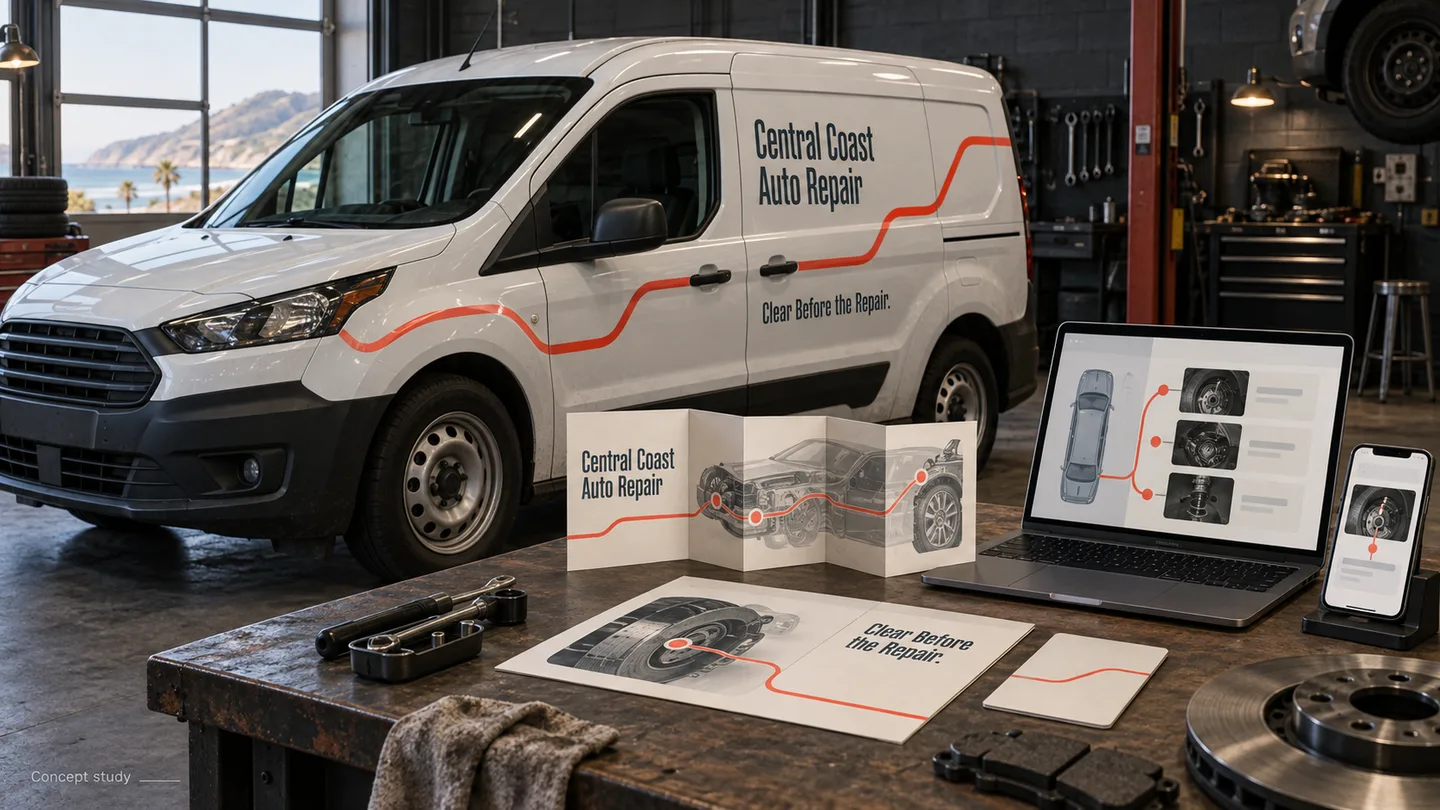
One red line connects symptoms, observations, options, authorization, and the completed handoff.
The idea, in every medium.
Know what’s wrong. Know what’s next.
Describe the concern, add a photo or sound note, and request an inspection. Findings and authorization stay separate so the next step remains clear.
No mystery under the hood.
Inspect. Explain. Authorize.
No mystery under the hood. Open the outdoor concept detail.Your next decision, mapped.
A single diagnostic trace travels from shop wall to vehicle, report, mailer, and phone without inventing a service list.
A launch, not just a look.
- Phase 01 · Listen
Document the real service journey
Confirm services, terminology, scheduling, inspection practice, pricing logic, contact routes, warranty language, and the questions customers actually ask.
- Phase 02 · Trace
Prototype one explanation system
Test the concern intake, findings summary, authorization record, shop signage, glove-box guide, and vehicle on real workflows before launch.
- Phase 03 · Prove
Build consented evidence over time
Publish approved repair stories, keep operating details current, and request reviews only after a confirmed customer handoff.
A fast concern builder collects symptoms, vehicle basics, optional media, timing, and contact preference, then hands the inquiry to a real person.
One verified identity, phone, hours set, address, and service vocabulary remain consistent across the site, Maps profile, directories, and structured data.
The diagnostic line guides arrival, key drop, waiting, approval, pickup, and after-hours instructions without turning the shop into a dealership.
A useful glove-box guide explains warning signs as conversation prompts—not diagnoses—and points to one current inspection route.
A findings sheet separates observed condition, recommended next step, customer decision, and future watch items in plain language.
High-contrast identification, one short message, and one verified contact path remain legible at road speed and around doors and seams.
A hypothetical Under the Hood Clinic produces short educational clips and question guides using operator-approved, non-diagnostic content.
A concise digital and printed handoff records approved work, operator-confirmed care guidance, and the correct route for a later question.
Grease-paper utility with one precise signal.
Charcoal, warm paper, muted service blue, and a single repair red. Cropped hands, inspection marks, component geometry, and annotated details replace generic sports-car imagery. The voice is calm: “Here’s what we found. Here’s what it means. Here’s what happens next.”
Observe clarity, not vanity traffic.
- Website, concern builder, service-journey copy, local identity standard, shop signs, report, mailer, event kit, pickup and van templates.
- Before production: verify services, licensing where relevant, hours, timing, prices, staff roles, policies, warranties, and review permissions.
- Measure completed inspection requests, qualified calls, directions, form handoff success, and authorization clarity only after a baseline exists.
Demo brand kit
A diagnostic system designed to survive oil, sun, paper, a small phone, and a moving vehicle. Open each tile for the proposed rules.
Palette
Prototype colors: warm paper #F4EFE4, charcoal #15191A, repair red #FF7862, and service blue #557780. Safety and substrate requirements would be tested in production.
TypographyKnown. Noted. Next.
A condensed display face carries short shop-scale statements; a generous system sans handles findings, estimates, forms, accessibility, and small field labels.
Graphic deviceThe diagnostic trace.
The trace can underline a finding, connect a sequence, become a vehicle stripe, or form a check mark. Red always signals the next decision, not danger.
Voice + materialNo mystery under the hood.
Plain, respectful, and specific. Durable uncoated stocks, grease-resistant field sheets, etched or painted signs, and reflective fleet details keep the system credible.
Open every artifact
01 · Website Concern-to-inspection front door
The experience begins with the customer’s words, then creates a structured request without pretending to diagnose a vehicle remotely.
- Content: concern, vehicle basics, optional media, timing, and preferred reply.
- Production: accessible form states, spam protection, confirmation, routing, and privacy copy.
- Constraint: services, availability, prices, and response expectations require operator approval.
02 · Signage No mystery under the hood
A shop-front line and simple diagnostic trace signal clarity without crowding the street-facing surface with services.
- Content: brand, one promise, verified phone or short URL, and directional information.
- Production: sightline, permitting, contrast, illumination, and material tests.
- Constraint: no unverified certifications or price claims.
03 · Direct mail Glove-box decision guide
A keepable foldout turns common concerns into questions to bring to an inspection rather than automated answers.
- Content: listen-for, look-for, write-down, and ask-about prompts approved by the shop.
- Production: postal-safe fold, durable stock, source code, and accessible web equivalent.
- Measure: qualified responses only after a baseline; no forecast is implied.
04 · Field card Findings and authorization record
The card distinguishes what was observed from what was recommended and what the customer chose.
- Content: finding, explanation, option, authorization state, future watch item.
- Production: carbonless or digital equivalent with readable retained copy.
- Constraint: legal and operational review before it becomes a service record.
05 · Clinic Under the Hood question lab
A hypothetical small-group clinic teaches people how to describe a concern and understand an inspection conversation.
- Experience: sound vocabulary, warning-light questions, maintenance records, and live Q&A.
- Production: demo-only components, safety boundaries, handout, sign-up, and follow-up.
- Constraint: no public event is announced and no remote diagnosis is offered.
06 · Measurement Clarity through the handoff
The proposed dashboard follows whether a concern reaches the right human and whether the customer can identify the next step.
- Primary: completed requests, qualified calls, directions, and successful routing.
- Quality: missing information, response-loop failures, and authorization questions.
- Governance: consent, retention, baselines, and owners defined before collection.
07 · Fleet + vans The diagnostic trace in motion
A pickup or service vehicle carries one decisive line and a minimal contact system instead of a moving service menu.
- Side: brand, short promise, and a trace that clears door handles and seams.
- Rear/parked: verified contact route and only operator-confirmed categories.
- Production: vehicle-specific proofs, legal marks, reflectivity, and installer files.
Public footprint snapshot checked September 6, 2026: Google Maps profile. The live profile showed 4.9 from 49 reviews and no working website action; a stale exact-name domain did not resolve. That is an observed search gap, not proof that an unindexed or newly launched official site does not exist.